
.svg)

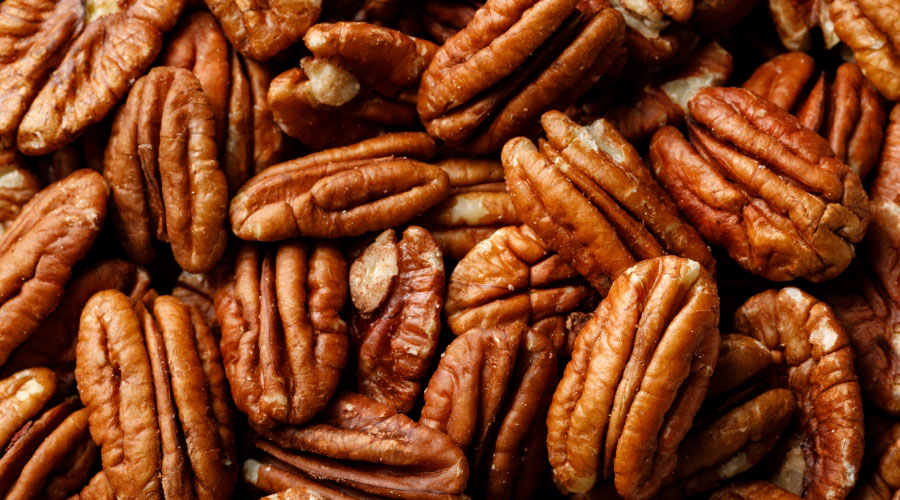
A true native of North America, the pecan has been harvested for centuries and remains a cornerstone of the continent's nut tradition, from baking to premium snacking.
Pecans are rich in monounsaturated fats and antioxidants and rank among the highest of all nuts for total antioxidant capacity, supporting their growing positioning as a heart-healthy ingredient. Demand is broadening beyond its traditional seasonal, baking-led market toward year-round snacking, with notable momentum in China, India, Japan and across Europe. The United States is the dominant producer, supplying roughly three-quarters to four-fifths of the global crop from Georgia, Texas, New Mexico and Arizona, followed by Mexico and a fast-growing South African industry, with smaller volumes from Australia. Because pecan trees bear on an alternate-year cycle and are exposed to weather events, global in-shell production fluctuates significantly from year to year, typically in the region of 300,000 to 500,000 tonnes.
Quick Facts
- The only major tree nut native to North America
- Name comes from an Algonquin word meaning "a nut requiring a stone to crack"
- Trees bear on an alternate-year cycle, causing 20–30% swings in annual yield
- Leading origins: United States (Georgia, Texas, New Mexico, Arizona), Mexico, South Africa
- Global in-shell production: roughly 300,000–500,000 tonnes (highly variable year to year)
- US accounts for around 75–80% of global supply
- Demand is shifting from seasonal baking use toward year-round snacking, especially in China, India and Japan
- Cold-pressed pecan oil is emerging as a high-margin gourmet product
Checkout our latest product



.svg)
