
.svg)

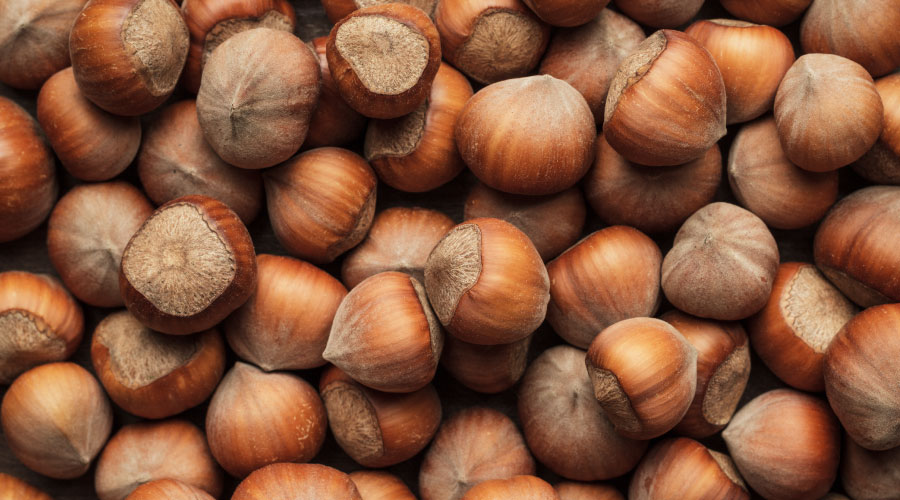
Cultivated around the Mediterranean and Black Sea for thousands of years, the hazelnut is defined commercially by its central role in chocolate, praline and spreads.
It is a good source of vitamin E, healthy fats, folate and dietary fibre. Demand is steady and growing, driven overwhelmingly by the confectionery industry, with newer momentum in markets such as China and across Asia-Pacific. Production is highly concentrated: Turkey alone accounts for around 60–70% of the world crop, grown along its Black Sea coast, with Italy, the United States (Oregon's Willamette Valley), Azerbaijan, Georgia and Chile making up most of the balance. Global production is in the region of 1.2 million tonnes, though it is notably volatile, as frosts, storms and pests in Turkey can swing supply and prices sharply from one season to the next.
Quick Facts
- Cultivated around the Mediterranean and Black Sea for thousands of years
- Turkey supplies roughly 60–70% of the entire world crop
- Ferrero alone is estimated to use about a quarter of global hazelnut production (for Nutella, Ferrero Rocher and Kinder)
- Oregon's Willamette Valley produces over 99% of US hazelnuts
- Leading origins: Turkey, Italy, United States, Azerbaijan, Georgia, Chile
- Global production: approx. 1.2 million tonnes
- Highly weather-sensitive — frosts and storms in Turkey can swing global supply and prices sharply
- Demand is driven overwhelmingly by the chocolate and confectionery industry
Checkout our latest product



.svg)
