
.svg)

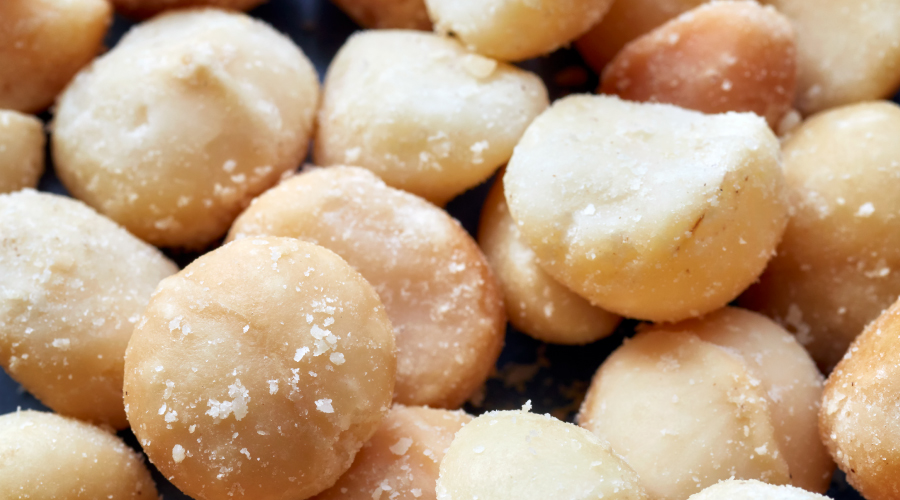
Native to the subtropical forests of eastern Australia, the macadamia is among the most prized and historically the most expensive tree nuts in the world, valued for its rich, buttery kernel and creamy texture.
Nutritionally it is distinctive for its high content of monounsaturated fats, the same heart-friendly fats associated with the Mediterranean diet, alongside fibre, manganese and thiamine. Demand has been one of the fastest-growing in the nut category: global kernel consumption is forecast to roughly double over the latter half of the decade, led by rising appetite in China, which has overtaken North America as the largest consumer, as well as steady growth across snacking, confectionery and food-manufacturing channels. Today the leading production origins are South Africa, China, Australia and Kenya, with emerging volumes from Guatemala, Malawi, Brazil and Vietnam. Global production reached approximately 340,000 tonnes (in-shell basis) in recent seasons and continues to climb as orchards planted in the late 2010s mature.
Quick Facts
- Native to the rainforests of Queensland and northern New South Wales, Australia
- One of the only food crops cultivated at scale that originated in Australia
- The world's hardest nut to crack — ordinary nutcrackers can't break the shell
- Doesn't bear commercial quantities until the tree is 7–10 years old, but can then keep producing for over a century
- Leading origins: South Africa, China, Australia, Kenya
- Global production: approx. 340,000 tonnes (in-shell)
- China has overtaken North America as the world's largest consumer market
- Global kernel demand is forecast to roughly double by the end of the decade
Checkout our latest product


.svg)
